Episode Transcript
[00:00:00] Speaker A: Yeah, it's like the worst thing that can happen is I lose everything and start over, but I've already done that a couple times.
[00:00:05] Speaker B: This is a very common symptom with a lot of entrepreneurs out there. They'll throw something out there to stay simple, and then the simple starts to burn them.
[00:00:12] Speaker A: I'm looking at our P and L and I'm like, why does it feel like we're not making any money?
Oh, I can't approach this like a traditional software at this point. They're getting enough value to where it's just a no brainer. Charlie's producing about $5.5 million a month in cash collected. You'd have to hate money to say no.
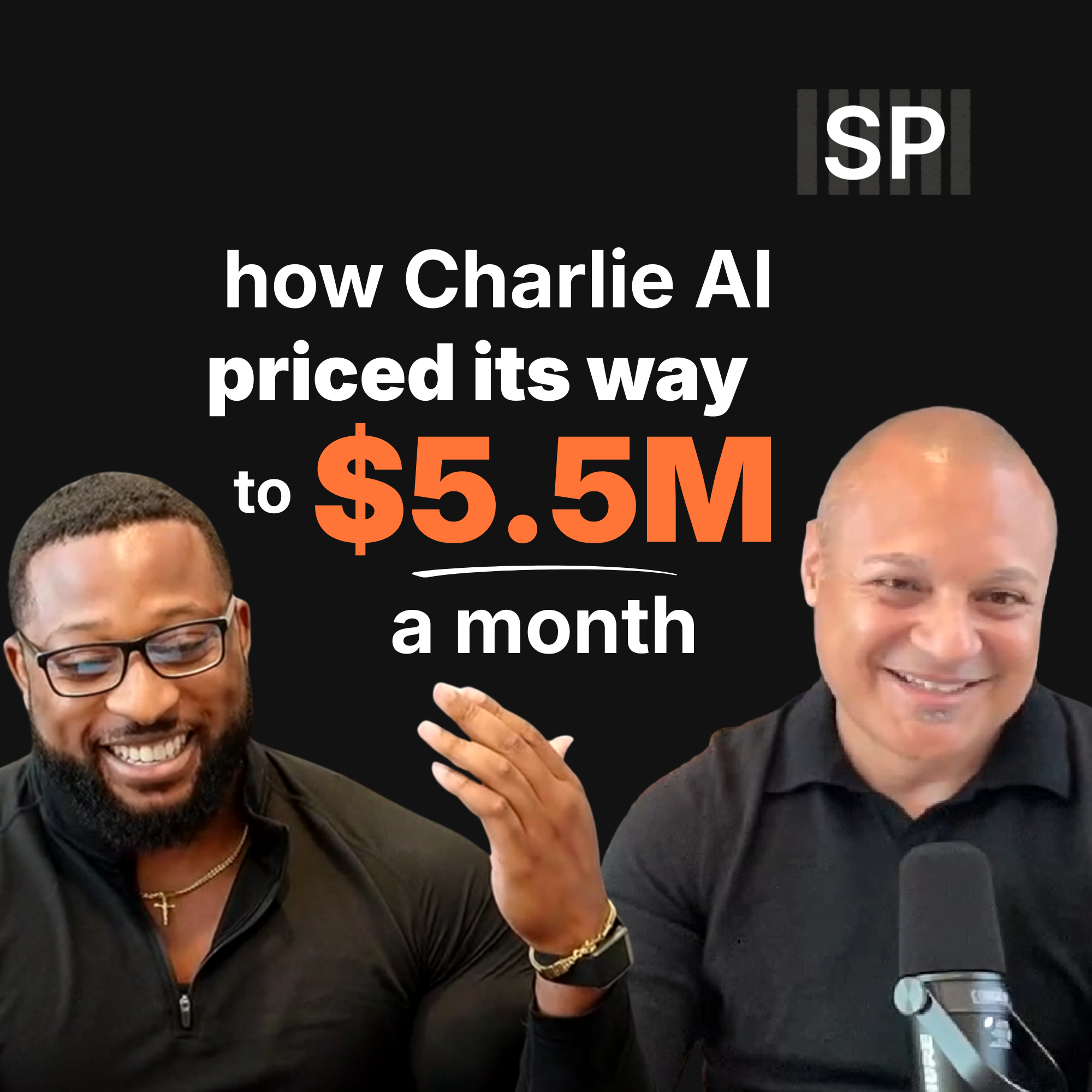
[00:00:38] Speaker B: I'm Marcos Rivera, and this is street Pricing, where I talk to leaders who are making decisions that shape their growth margins and how they make money. Today's guest built his career on pattern recognition, first as a fitness trainer and then as the founder behind Charlie AI, the tool that's now collecting $5 million a month with by pricing itself based on performance instead of a flat fee. In this episode, we'll meet Iggy Odigizua and get into why he threw out traditional software pricing and the philosophy shaped by growing up in Nigeria and starting over multiple times that makes him fearless about taking that risk.
Let's get into it. You mentioned that you had a different upbringing than most folks, right? Living in a village from Nigeria. I want to hear more about that. I'm from the Bronx, I'm from New York.
Yes. I grew up in poverty, but there's, I think, stages of poverty. Right. And the way you grow up, I think shapes the way you think. I want to. I want to hear about your upbringing and how that shapes the way you think.
[00:01:32] Speaker A: I was born in Ohio, and when I was 2, my dad sent me and my older brother to live in Nigeria with our grandparents. And we ended up being there for about like five and a half years.
So as a kid, it was very traumatic being there. And ultimately, I mean, every single day, it was a. It was, it was a fight to get food, a fight to get to school.
At school, because we were from America, we had to fight, like, every single day. So finally when my mom brought us back after like five and a half years coming back to America, it was a bit of a culture shock because there was electricity. I haven't had electricity for like five and a half years. You know, lamps and candles and, you know, there's no such thing as a toilet, no baths or anything like that. So you're, like, doing everything outside in the open. So coming back, it was a culture shock of, like, a completely new world, right? And then going back into school.
And the biggest thing that was while that school was how disrespectful kids were to their teachers. Because in Nigeria, like, respect is a very big thing. Like, you don't talk back to your elders. Especially, like, your teachers, they have the ability to spank you in school if you're out of line. So for me, like, looking at all these kids talk back to their teacher, I'm like, why don't you just slap them? Like, why.
[00:02:59] Speaker C: Why are you letting these kids disrespect you like that? Like, why don't you just smack them in the mouth? Because that's what cross. That's what they would do in the village. And you couldn't go to your parents and be like, hey, like, this teacher, his hands on me, they're like, what you do? Oh, you were being disrespectful. Then you get spanked twice. So the teacher spanks you, and then they're gonna spank you for being disrespectful to your.
[00:03:24] Speaker A: To your teacher. So, yeah, it was just, like, really weird to me coming back. I was just, like, observing how these kids were behaving, and I was just like, it is so strange that nobody's doing anything to put these kids in line.
[00:03:39] Speaker B: Completely, completely understood that. Listen, being raised from a Latina grandmother, my grandma raised me for most of my life. And, yeah, you best believe if I was out of line, she would put me back in line. And you always want to respect your elders. It's always, you know, yes, sir or, yes, ma'. Am. You don't talk back. Very different. I think sort of way we view respect and. And discourse around respect, it also helps you kind of read situations a lot better, right? I'm imagining moving from one culture to another and back to another.
The shock in terms of reading a very different society. What's normal, what's not normal, things like that. Right? So how do you think that stuff shaped you as you were going through school trying to better yourself and then moving on in your career? How do you think that helped you out?
[00:04:33] Speaker A: I mean, the biggest thing was learning how to set boundaries. You know, when I first came back in Nigeria, I had to fight, like, every single day. I'd be in a ton of fist fights. Some I'd win, most I'd lose. And then, like, coming back, I didn't want to fight anymore, so I just wanted to Just be easy. And we were, like, one of, like, five African American kids at the elementary school. So we stuck out like a sore thumbnail, and we got bullied. And I would just let the kids bully me because they were, like, to the extent that they were being harmful, was just calling me names, right? And maybe, like, slapping things out of my hand when I'm carrying them. Like, these kids are like, they're not a threat at all. But the more I would let that go, the more and more would just escalate, right? So it goes from name calling to then being a little physical to then, like, pushing and then, like, hitting. And then one kid stabbed me with a pencil, and then I just lost it and beat the snot out of him. And the teacher was, like, freaking out because they've never seen me, like, react.
And so to take us to the principal office, and the other kid gets suspended for a few days, and nothing happens with me because the kid teacher was like, I've never seen him act out. He's been here for a while. He's quiet, keeps himself. And I just told him, like, he's. They've been bullying me. And then he stabbed me with a pencil. And I felt the need to defend myself. And then the next day, all the kids that were bullying me nightly difference now, that cheated me.
So I was like, okay, they were bullying me because I was letting them, right?
[00:06:10] Speaker B: Let it slide.
[00:06:11] Speaker A: Now they know that I've got more than what it takes to defend myself. And now their behavior have changed so very quickly. Started to make some friends, right?
And then we had to move again.
And this time when I moved and started at a new school, I let everybody know. I'm like, my name is Iggy.
You can call me a variation of that. But if you call me anything than what I want to be called, we will have problems. So I set the boundary. From day one, it was a very different experience going through school, moving forward, because I'm like, I'm gonna treat you in a very respectful way, and I expect you to treat me the same way. And so long as we treat each other fairly, like we're gonna be. We're gonna have a good time, right? And you can express yourself however you want, but you don't get to treat me however you want, right? Yeah. And that was, like, a radical experience that just kind of shaped how I interact with people. Moving on. And I saw my brother, he never got that same lesson. He always end up maintaining, like, being reserved. So I always had to be the one to be like, this is how you treat me and my brother.
Right. And set the boundaries there.
And so that's shaped like, how I run business. I'm not afraid of confrontation. I'm not afraid to hold the line. I'm not afraid to kind of like go there with people.
Because I learned early on you kind of have to if you want to be treated the way that you need to.
[00:07:41] Speaker B: That's right. You set the tone at the end of the day. Right. So, yeah, we.
One thing that I've learned in my entrepreneurial journey is there is such thing as entrepreneurial bullying. Let me explain that a little bit more. It's probably a new term, but think about clients who don't care about whether it's a 5am meeting or 11pm meeting, or use that leverage on you to get more work or free work or to push your prices down. Employees that maybe don't listen to your direction and do their own thing and don't take your. Your vision or clarity seriously. I could see, like different layers or levels of bullying. And if you don't establish. This is what I'm about. These are the boundaries. Here's how we're going to work together upfront, then. Then they will establish it for you, is what I'm saying. Right. So that's a key thing. That's a key thing right there, man.
Give me, give me. There's something about your background I thought was super interesting, and it was further along where you were a fitness trainer. A lot of people don't know is I was also a fitness trainer for many years. I worked at 24 Hour Fitness, B Total Fitness. I worked at like four different places and I had my. My book of clients. It teaches you how to hustle, it teaches you how to sell, it teaches you how to read people.
[00:08:55] Speaker A: Yeah.
[00:08:56] Speaker B: Even at Alex Hormozi, right? The big, you know, author, podcaster out there as well. He was a fitness trainer in his early career. I don't know if there's something about, like, having to go through that. That gauntlet.
[00:09:06] Speaker A: I think there is. I think there is.
[00:09:08] Speaker C: It's like people don't understand.
[00:09:10] Speaker A: It's a different kind of, like, it's to build a successful fitness business. You're playing entrepreneurship on hard mode, I believe, because it's a consumer product service that you're selling and you're in. It's not like ROI based. Right. So you're having to do more emotional kind of selling and it's a commodity. Like, the barrier to entry is just looking like, you know, what you're talking
[00:09:37] Speaker C: about, like, meaning being in good shape. You really don't need to be an
[00:09:42] Speaker A: expert to get in, but you learn how to hustle, you learn how to grind. You learn sales at a really high level because you're having to convince people to take a bet on looking better in the mirror.
[00:09:57] Speaker B: And it doesn't only rely on you, it relies on them, too. Like, there's two sides to that that you got to motivate through. And I. I completely agree. I think it's at the highest level. You. You don't train, you don't eat, in many ways, at least that's the way it was at the gyms I worked at. So here you are, right? You're. You're. You're. By the way, you're pushing Charlie AI now, right? I got to know. Yeah, tell me about Charlie AI.
Tell me, like, what are you trying to do here? Right? Because there's. There's no shortage of sales tools out there to help people sell more stuff, right? And I know you probably heard some pushback. Like, hey, man, this is something else I got to hear. What are you trying to do? And. And why do you think this is a calculated risk that is worth the payoff?
[00:10:36] Speaker A: I'm building Charlie for myself. So at the peak of my fitness, my online fitness business, we had about 40 setters, SDRs, and about 60 sales reps.
It was just an administrative nightmare. Growing that business. It was a revolving door. I discovered AI back in November 2021. I remember, like, it was right before Thanksgiving, so I had a little break for Thanksgiving, and I just went down the rabbit hole and built this disgustingly complex messaging flow because I was tired of looking at the messages that my SDRs and setters were supposed to be. There's a very extensive script that I built out for them to follow, and I was auditing their pipeline, and there's so many leads that just were not being responded to. It was just ridiculous. I'm like, we got 40 people. How are we missing leads?
So I built that flow and launched it the next week, and it was able to do, like, 60% of the work.
And then I just had to go in and keep manually iterating until it got to a point where it was doing, like, 90% of the work. So that was, like, the MVP of Charlie. And I saw firsthand, and AI then wasn't intelligent at all. It was pretty rudimentary, very prone to error.
So I was working on that, and then ChatGPT launched. I think it was like, 2022. 2020.
End of 2022.
[00:12:08] Speaker B: Right.
[00:12:09] Speaker A: So when real intelligence came in and I was like, well, I think I've seen it firsthand what it can do for my own business. And it was. Wasn't that good.
And we went from 40 setters to like, 12 to, like, three, and stayed at, like, three setters that were just doing QC for the AI. And that business has continued to grow without any setters on the sales floor. So Charlie is. Was built for my own thing. And then we just got a lot of businesses that were like, hey, like, how are you doing this within your business? Because we're teaching other fitness trainers how to launch our own online fitness businesses at the time. So I felt the pain firsthand, and I tried to find tools to solve it, but it was very clear that the tools that were being built were being built by people who didn't really understand what the pain was. So there were technically sound tools, and there's lots of technically sound tools out there.
But when you actually start trying to use it within the sales context, and if you don't understand the nuance of sales. Right. And you start trying to use a tool that wasn't built with a sales mindset, first, it becomes very clear that there's a gap.
Right. So Charlie's built first with the business use case in mind.
Right. I didn't have the technical chops to get it to where it is today technically, but it worked out the box because I built it first with the mindset of implementing it into an actual live business use case and then burning a lot of leads. You know, like, we spent over $10 million growing that business, and most of it was through Charlie. Right. So burning a lot of leads in. In the process of understanding the nuance and how it needs to show up and communicate. I think that's been the biggest difference is we're building it with business in mind, and then I'm also building it for my own businesses.
And so it allows our users to come in and see, like, it makes sense to them, because they're like, okay, it very clearly. This was built so that I can seamlessly plug into my pipeline right now.
[00:14:24] Speaker B: So you eat your own dog food. Like, you know it works because you use it yourself, right?
[00:14:28] Speaker C: Yeah.
[00:14:29] Speaker A: I mean, right now, across our portfolio, Charlie's producing about $5.5 million a month in cash collected. Wow. Without any human setters. So I'm like.
[00:14:39] Speaker C: I'm like, show me another product like Charlie out there where the owner is
[00:14:44] Speaker A: actually building businesses similar to the companies that are needing the product. You know what I mean?
[00:14:52] Speaker B: That's crazy. And you're just getting started. I know you're going to keep building on top of this more and more, right? But how much more proof do you need? Right? You went from you said 40 down to like three and you tuned it. I think that that learning tax that a lot of people have to pay to really understand the nuances and it's that depth of understanding that actually allows you to build something that really works, right? It's not just I'm a geek and I'm going to throw, you know, tech on top of something. You actually really learn. Real quick. I want to tell you about something my team's been building. It's called Curve. So many of the companies we work with run into the same problem. Their pricing lives in spreadsheets, old decks, email threads. Nobody actually owns it. So it doesn't change when it should. And when it finally does, it's a guess. Curve fixes that. It connects straight to your live sales data and shows you the actual impact of a pricing change before you make it. Every decision log and easy to explain beta is open right now. If you want in, go to pricingio.com curve that's pricingio.com cuz. RRV. All right, let's get back to it. So with the 5.5, which is super impressive, I got to ask you this question, man. Like, how did you figure out what to charge for it? I think you're charging a couple thousand dollars, right, A month on it.
You know, this thing works.
So I want to know how did you come up with. All right, here's the business model. Here's how I'm going to charge for this thing.
[00:16:18] Speaker A: Trial and error is really kind of like what, what happened?
And also listening to the market. So we initially, I initially launched it like a traditional kind of high ticket offer where we charge like 10 to like even as high as like 100k up front for the build out, depending on like how extensive it was. And then that'll give them X amount of time included and then the retainer will kick in, right.
And so everyone that would have been that we could have serviced at that level we were able to service.
And then more and more tools started popping out and so people were like, well I can just go here and do that. And so we had to kind of go through this cycle of trying to figure out like where, what is the best way for us to position it in a way that makes sense.
And so I just looked at like what Was I paying my setters right? We're paying our setters anywhere from $1500 to $3000 a month as a base and 5% of cash that they produce.
So we split it down the middle. Charlie's 2,000 bucks a month. And at the time we weren't doing any type of commit like commissions and we weren't charging any kind of overages.
[00:17:31] Speaker B: So it was just straight up, we
[00:17:32] Speaker A: had people coming in, it was just straight up $2,000 a month. And I thought we were doing good one month. I'm like, man, we got all these, some big accounts that we've onboarded and I'm looking at our P and L and I'm like, how, why does it feel like we're not making any money?
[00:17:50] Speaker C: I'm like, I feel like we're just burning through so much money like it, why does it not feel like we're making anything? And so I'm going through the numbers
[00:17:59] Speaker A: and we had some high volume accounts
[00:18:01] Speaker C: that were just killing us on the API usage fees.
They were paying us $2,000 a month and their usage was costing us like 12,000.
[00:18:13] Speaker B: Right. That's a huge, that's a problem.
[00:18:16] Speaker A: And so I'm like, oh, I can't approach this like a traditional software because we have, our costs aren't fixed. So I had to like repackages. Had an interesting conversation with that client. I was like, hey guys, we're going to have to readjust how high you're being built.
We're able to successfully navigate it, but it was just one of those things where it's a very, very painful lesson. And I was like, well we, in order for us to do this right, how much can we afford to include up front in terms of how much can we afford to eat in terms of usage? And then when does it make sense to pass that fee over to the user?
And we calculated it out to where like at this point they're getting enough value to where it's just a no brainer.
So that's about like, I feel like 10,000 AI generated responses is what we've worked that out to be for our average user. And once they've exhausted that on average they're typically seeing a 4-5x return on their investment in the platform.
And then anything incremental past that is like a fraction, right? It's like 15, 15 cents on average is what it costs them to get a qualified booking through the platform once it use all the credits.
[00:19:38] Speaker B: Got it, got it. So that's how the overage Kicks in a couple things. I mean, I don't think you did anything wrong or unusual in the beginning. Right. You sort of look for, you know, how would people anchor this cost or this expense? They're not, they haven't seen AI like this applied to setters in, you know, in comparatively. Right. They probably have some notions. They probably worked with a chat bot and screamed the representative like five times before it freaking moved them.
[00:20:04] Speaker A: Right.
[00:20:04] Speaker B: So they probably don't have a lot of trust. You had to build that trust. So going down with something familiar to build a trust, keeping it simple, not a lot of variables moving around isn't, that's not terrible. Right. But what ends up happening though is you ultimately, ultimately start to prove out, hey, this is actually working and getting some return and thinking about like, here's the return you get for the investment and I bet you that return was starting to look ridiculous even in the
[00:20:30] Speaker A: early days for the accounts that it hit. It was insane. You know, and that's where we started to adjust our, our model to be more performance based where the other flat subscription and then they're still covering their usage but then because it's such a discrepancy between what they're paying and the value they're getting, like just give us like 2% of, of the upside that's being created, you know, and that's been working out really well because it is performance driven and our team is very hands on in optimizing it because you know, business owners that are successful don't want to learn another tech. So that's one of the things we have to learn early on is we need to set it up for them and we need to optimize it for them. But we can't set it up in a way where we're incentivized in a way where it's like our incentive is to continue getting more accounts and not being able to spend as much time with the ones that we are that we're working with. So we have to align the incentives and the new pricing structures kind of like allowed us to do so. So that as you're getting more successful, you're paying us more. But then that also means we're able to allocate more resources to ensure that you continue to be successful.
[00:21:47] Speaker B: That's right. I think performance based does create that alignment. It's not often easy to.
One thing people really forget about performance based is that there's a trust factor up front.
The problem with performance based, if you don't do it right with the Right. Trust or if there's a misalignment with how much they're winning and in, in your cut you start to get, it starts to feel like attacks I think is the other way. Right. And you want to avoid that with trust meaning high probability that they're going to get the outcome they want which then gives the confidence in the solution and then that, that exchange, that ratio. I can, I can go all day about what the ratio looks like but oftentimes the ratio is it actually correlates to how big the deals are. It's a little bit weird but if you've ever seen in real estate, naturally even the bigger houses you sell, the commissions go down from 6 to 4 to 3 to you know, it's. There's a certain quantity sort of exchange back there that you have to meet and stay below in order for you to win that performance based. And then here's the last piece is over time as volume goes up, the ratio actually changes in their favor a little bit better. Every time you reach a milestone and keep going the exchange ratio or even the percentage cut or whatever you want to call it or the bonus, it changes a little bit. And so in a way optically right. They look like they win a little more because it gets per unit cheaper, per $1 cheaper with you which is
[00:23:13] Speaker A: what you want 100%. So that's been like the, it's still early as far as like the performance based. We got a few accounts on that but it's very clear that it is going to be like the path forward for us to like continue to grow and ultimately allow our users to be come more valuable to us as we're becoming more valuable to them. So our need isn't really like Charlie, I'm not trying to tap into hyper growth with it yet. We're being so very selective about who we onboard into the platform and the focus is like really getting high quality use cases, making sure our processes are really dialed in. And then it's as we do that, I mean the reputation of the platform is growing pretty rapidly just because the amount of users that are seeing great results on it is pretty insane. So that's been, it's been fun to watch. I can't grow it as fast as I normally would with any other business that I'm.
That I would build. So it's been a different kind of patience, different kind of hard like having to wait and make sure like we have the infrastructure to support explosive growth.
But it's been cool. It's been hard but it's been very, very rewarding seeing it come together just like an idea to solve my own pain. But then now seeing other entrepreneurs who are in the same kind of pain point, saying, like, I love running my business again because I don't have to deal with this revolving door that is trying to build a team of setters,
[00:24:52] Speaker B: you know, No, I think that's high value and obvious value. They feel right away. You're. And by the way, the balance you're telling me is, I think, a big lesson for a lot of entrepreneurs out there. There's. There's the. The progress that you make, which you have to make enough progress that you were embarrassed with your product that in the state that it was 12 months ago, okay. But at the same time, you want to be patient to let things develop, to let things sort of grow and fill and sort of meet those levels, because you can die from. From indigestion just as much as from starvation. And so you want to be careful not to get too ahead of your skis. I think those are two key things. There is one line that you said, though, that really jumped out at me. I was looking at one of your posts and you said, I am willing to go through eating in glass, right? Like, the process of doing that.
[00:25:37] Speaker A: And that's.
[00:25:37] Speaker B: I was like, this guy, right? Like, what is he now? That, by the way, now that you described, like, the multiple trips to Nigeria and sort of the way you learn, like, actually going through it, like the whole experience with the trainer now I understand a little bit more, have more appreciation, but. But you got to tell me, like, unpack that. That line for me, for me is just.
[00:25:56] Speaker A: I get excited when it's.
It's really hard, you know, because I know what comes on the other side of that hard. And most people just aren't willing to stomach that kind of pain, you know. So for me, the process of eating in glasses is learning, is failing intelligently. It's getting reps and building nuanced level of understanding in the process of doing the thing.
And so for a while, our motto is, like, we just.
[00:26:25] Speaker C: We just gotta stay in the game long enough.
Like, we just have to not die.
[00:26:32] Speaker B: That's the key. Don't run out of money. That's the big one here.
[00:26:35] Speaker C: That's what, you know, like, we just have to not die. But I think we can figure this thing out.
[00:26:40] Speaker A: So our mindset is we look forward and we lean into the pain, right? So.
And in the time, in the period on their path to success, there's a Period. Everyone goes to where they're eating and glass, but nobody notices them because it's not. You don't want to sit there looking at someone, get their face kicked in.
[00:27:04] Speaker B: Yeah.
Kind of win a little bit.
[00:27:06] Speaker C: You don't want to be around someone who's doing that.
[00:27:10] Speaker A: Right.
[00:27:11] Speaker C: So you fly under the radar once
[00:27:14] Speaker A: you reach critical mass and then you start getting momentum and then people start noticing and they're like, oh, wow, like you're an overnight success. So like, no, I've been eating and getting my teeth kicked in for the last 10 years. You just haven't been looking because there was nothing to look at.
[00:27:29] Speaker B: That's right. The, the, the five year or ten year overnight success that, that we see out there in the world today. Right. But your, your point well taken, man. You don't want to eat in glass and then just go home. Like, you actually, like there's a, a what I call productive pain that comes at the end of it.
[00:27:43] Speaker A: Right.
[00:27:44] Speaker B: Pain that, that creates perception or perspective, that, that helps you get better, that helps you see change things moving on. Right. So I fully subscribe to that in lots of ways. When I, when I think about the new changes you're making to them. So that, that $12,000 cost for 2000, like that, that's a little bit of pain that you're like, ooh, we, we need to change that. And think about businesses. You want to make sure you add value. Okay. You want to make sure you're building something that, that materially changes their situation and that they're willing to pay for. And sort of the journey to get to that change isn't also a pain in the ass too. They want to get to that change in a reasonable time and effort. And, and then when you charge the part that I love that you're still experimenting around with the performance base. You know, you got to build that trust before you get to the right level of cuts. And then you got to give them scale as they increase volume with you performance based. You do those two things, you're going to win on a performance based front. And a lot of people are worried about charging on a performance basis. Right. And when a customer or say looks at you and say, hey, hey Iggy, there's a competitor to you, they claim to be able to get me the same results that you're going to get me, but they're not going to charge me on a performance basis. They're going to charge me 5k a month flat. What do you say to that?
[00:28:58] Speaker A: Go ahead, go do it.
It's a little way for me. It's like I, anytime somebody brings up like a competitor, I'm like, yeah, they're a great referral partner for us. You know, people go to them, use them for a couple months, find out about us and, and switch over. I love those guys. I, I hope that they continue to be successful, you know, because there are some of our best referral partners.
So for me it's just about, I know what we, what we can do and it's not even, we just have, I've got too much evidence of the quality of the work that we do. So there's nothing you can say as a prospective client that's going to change that. Because I have much greater conviction than you in the quality of the product.
Not because I, I'm have no touch in reality, but because I can pull up a hundred different accounts that are producing 1030, even 100x what they're paying us in exchange. You know, so that's where that kind of like the mindset comes from is the fact that we just have too many, too much evidence of what the product can do. And if we believe it can help you, then we know for fact, like that's coming from a place of certainty, absolute certainty, with a disgusting amount of data to back it up, you know, so that's why we're selective about who we take on. Because if I'm like, I don't have enough confidence in your sales process that we can provide the kind of value that you need for us to justify enrolling you.
But if you have a use case that I'm like, dude, I've got 30 use cases just like yours on our platform right now. Absolutely crushing. Here's exactly what we need to do to get this thing spun up inside of your business to deliver results in less than 14 days. You'd have to hate money to say no.
[00:30:58] Speaker B: Yeah, that becomes a no brainer, right? That becomes, you know, you feel silly saying no or if you do say it, the one thing I, I liked about what you just said is there's an experience and evidence based conviction, right? And so I've seen this work. I know how this plays out. I have the evidence, I have the data. Without evidence and data, you might be, you know, drinking your own Kool Aid or smoking something. With experience and data together and driving conviction, to me that goes back to the old adage about confidence, right? I always say pricing's about confidence and it's all in my, my book and I talk about pricing is confidence. If you have conviction in the value you give and you know you can deliver, then you could stand by your price. You know, you can understand what that exchange looks like, or you can at least build a path to get there.
[00:31:48] Speaker A: Yeah.
[00:31:49] Speaker B: And I think at the end of the day, if you're missing that piece, right. A lot of time when I, When I dig into pricing problems, man, it's like, all right, do you even believe your own value for a second? Like, just sit there and tell me what it is. And we always have to go through that piece first. But, man, when you have experience and evidence behind what you do, it becomes a lot easier.
[00:32:07] Speaker A: Yeah, absolutely. It's like, I know for me, when I was building my personal training business, I could step into a room and there was no doubt that I knew what I was talking about when it came to, like, getting in shape.
[00:32:20] Speaker C: Right.
[00:32:22] Speaker B: Gee, I don't know, man. Your arm's the side of my body right now. I think it makes sense.
[00:32:25] Speaker C: This is one of those things where, like, if you've got enough evidence that it's just like, I've got a basis for, at least I'm. I'm able to prove that it works for me.
[00:32:37] Speaker A: Whether or not the same thing work
[00:32:38] Speaker C: for you is yet to be determined, but you can at least know that it works for me because I'm doing it.
[00:32:45] Speaker B: Yes. And I think there's a direct connection that people use when, in their decision making process. I think when that line is very clear and direct, it helps them sort of take that step forward. You said something, the opening, like the whole beginning. You said something about your years, your wisdom beyond your years. Right. I mean, you still got a lot of career ahead of you, Iggy. Right? But you've learned so much. A lot of lessons. I gotta know, man. Like, if you're sitting, you know, in front of an aspiring entrepreneur and they wanna, they wanna be successful, they wanna make something of themselves, like, do you have like that one biggest lesson that you learned, you know, in your journey that you would tell that person, like, what's the big one?
[00:33:25] Speaker A: The biggest lesson? For me, the pattern comes up over and over again.
Get in the right room and get the right information like this. Every, Every point where I've been received, it like an inflection point in my career so far, it's just been being around the right people and getting the right information, but being prepared to take advantage of it.
So my mentor used to tell me, everything's preparation and don't waste your suffering. Document the lessons that you're Learning and look for the lessons in the hard times.
Because all those things are like preparations from God so that when an opportunity comes, you are in a position where you could take advantage of it.
So always be preparing.
Don't waste your suffering. And then knowledge and proximity, right? Get around people who are doing the things that you want to do at a high level and learn as much as you can from them.
And you put those three things together and, you know, it's hard to not be where you want to be. Success is like an inevitable outcome if you're just willing to do that long enough.
[00:34:41] Speaker B: Yeah, yeah. Truer words, man. Truer words.
Don't waste your suffering. I kind of like that one a lot. I think that.
Make it count, right? Make it count. Plow forward. And the big goal here, I mean, just to be real with me, right, Charlie, if you're able to sort of have things play out the way you want it to, like, what would happen? You get acquired, you sell it, you grow it.
[00:35:04] Speaker A: It'd probably be a strategic acquisition between 2028 and 2029, and we'd probably be acquired by a company that their users are becoming more valuable to them as a result of them using our product.
So right now, on average, with the CRMs that we integrate with their users, their usage typically goes up by 5, almost as high as like 10x because of how efficient Charlie's working, their leads, and their return on Aspen. So because their return on Aspen is so good, they're able to invest more into their marketing and growing their. And scaling their business, which also increases their usage on the platform and makes them have to upgrade into different tiers.
And so I have a feeling that there's. Once we get to critical mass, these CRMs that we're integrated into are eventually going to be like. Well, out of all of our users,
[00:35:59] Speaker C: like the ones that are on this one app are paying us 5 to 10x more money.
So what can we do to lock
[00:36:07] Speaker A: them up and, and make this thing official? That's kind of how I, I see it potentially playing out. If we just keep our head down and keep doing what we're doing and executing at a high level for the next three to five years.
[00:36:21] Speaker B: I think that's, that, that's a very, I think, tangible and realistic outcome and a good way, by the way, to compete in a space that's a little crowded when you're seen as the one that can generate more results and output for another solution or system, they usually gobble you up. They'd rather buy you than try to compete with you out.
That makes tons of sense, man. Iggy, man, thank you so much. Just a real heartfelt thank you for coming in. We can stay in touch, man. There are a lot of parallelisms in our lives, and so I want to make sure that we stay in touch.
[00:36:56] Speaker A: I'll definitely be in touch. I want to pick your brain on a lot more as far as my first software company that we're building. So very new to the game.
Looking to learn as much as I can because I don't know what I don't know. So
[00:37:12] Speaker B: happy to help, man, in any way, shape or form. You just let me know.
[00:37:14] Speaker A: Got to pay that ignorance debt down as fast as I possibly can.
[00:37:18] Speaker B: If you're looking to scale your SDR function, check out Charlie AI. I got a link in the show notes for you.